
A kickabout in Illyria
The first of a two-part series exploring Albania, past, present and future

When I was a young diarist on the Evening Standard, we had quite a thing for Albania. The family of King Zog, the monarch deposed on the eve of the Second World War, was a great source of stories. It didn’t really matter how strong the story was: we took any excuse to mention a king who sounded like he was from Flash Gordon and looked like a ruler from a Marx Brothers film.
Then a regular contributor unearthed a 1967 speech in which the Albanian Communist leader Enver Hoxha made as he welcomed – if that’s the word – the new year in.
It went:
This year will be harder than last year. On the other hand, it will be easier than next year.
That line gets trotted out by political commentators from time to time. In the early days of the current Labour government in Britain, there was a lot of Hoxhonian talk as they tried, with a notable lack of success, to brace us for hard but necessary cuts.
Even by the standards of Stalinist dictators, Hoxha was not much of a lad for a merry quip. But the joke, for the past six decades, has very much been on Albania. For most of that period, it was isolated, poor and (if a beautiful land ringed by sublime mountains, deep lakes and sparkling seas can be this) grim, where the only certainty, indeed, was that the next year would be worse than this one.
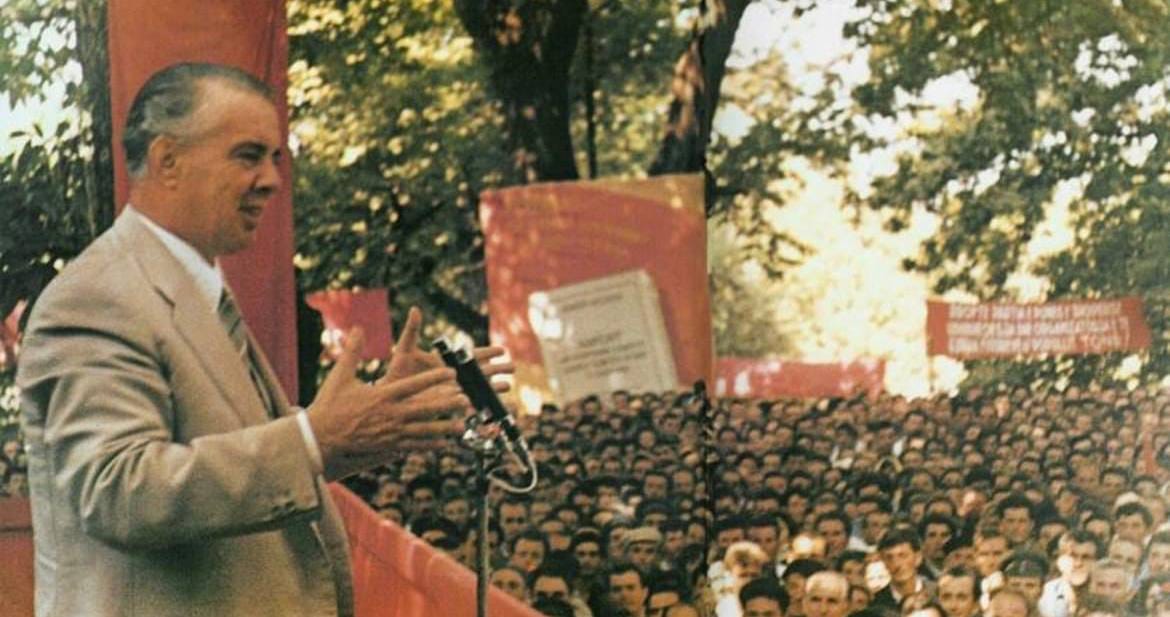
Hoxha: you’ll never have it so bad
No longer. Albania is now a country where next year, and the year after that, will, or should, just keep getting better and better. It’s an upper-middle income country growing at a fair (3.5%) lick. It is perhaps the most exciting tourism destination in Europe: beautiful, cheap, historic – and emerging, with loads of bold new projects on the horizon. Albania is where Croatia – expensive and overtouristed, wearily resigned to competing with Italy and Greece – was 30 years ago.
The only thing Albanian tourism has been lacking is a visit from that most intrepid of former south London pub football teams, the Racing Club de Blackheath.
The RCdeB blazed a trail1 through central and eastern Europe as the former Iron Curtain countries opened up in the 1990s. Once those places became established, the team took its creaking limbs and unreformed British tactics to places like Cuba, Syria, Iran, Pakistan, Burma and Uzbekistan.
Associated with what kind of intense light was the omission of Albania from the Blackheath global touring itinerary? Glaring, that’s what.
So in May 2026, we went.
Decrepit, ruined yet somehow full of charm
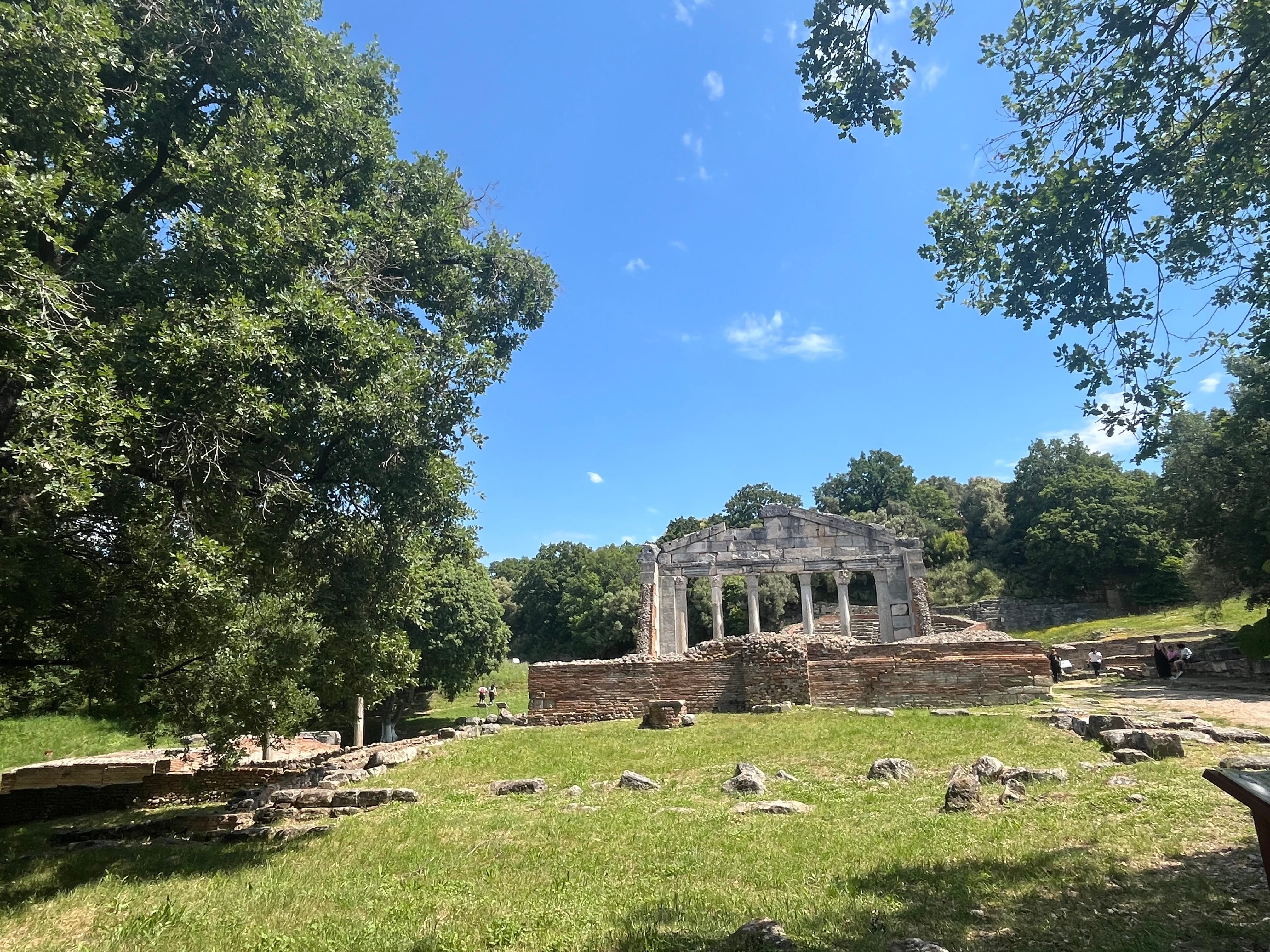
That subhead refers to the archeological site of Apollonia (above) rather than, say a touring group of British footballers (below)
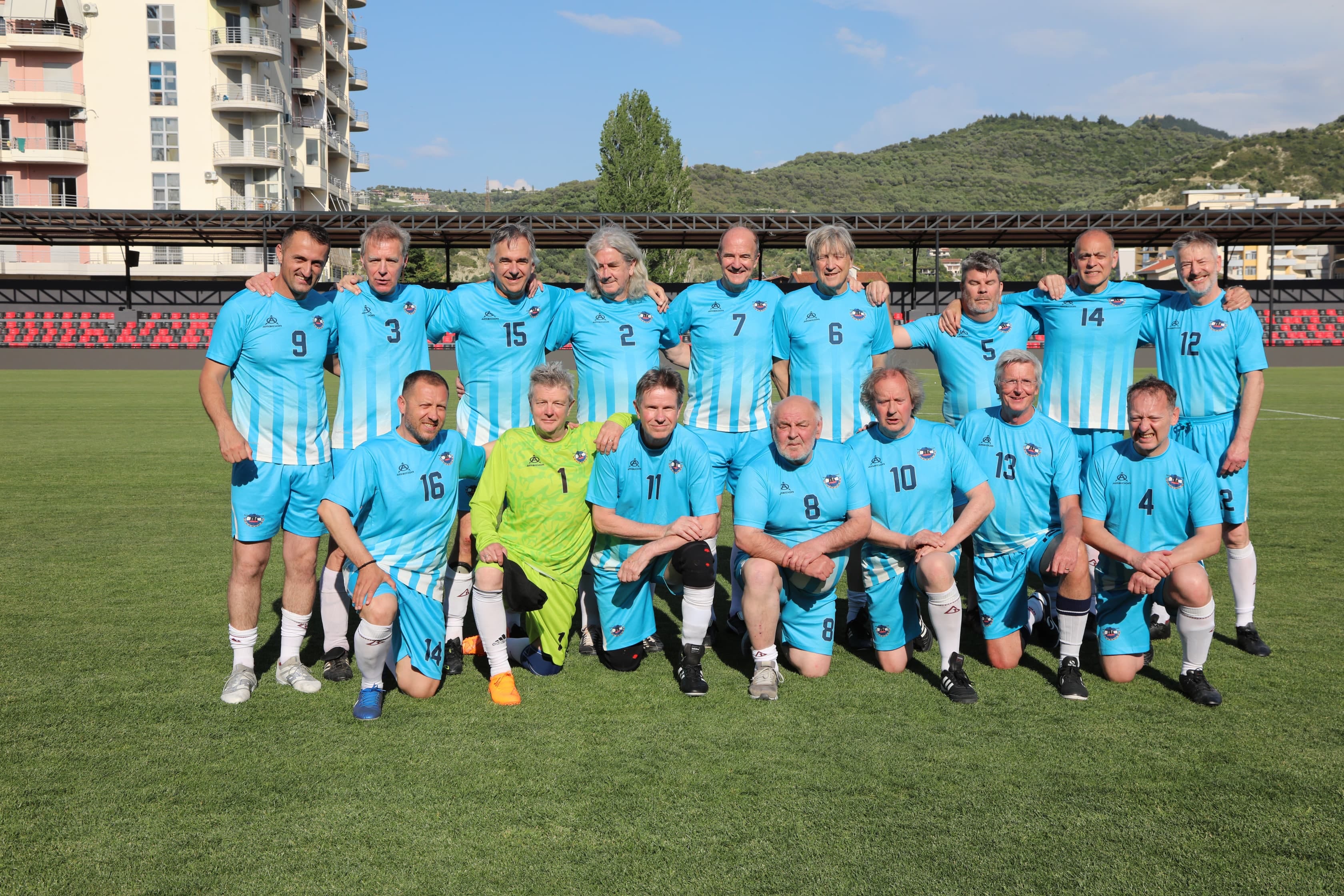
We’ve seen some ruins, our team has. Baalbek, Palmyra, Tyre, the temples of Bagan, the monoliths of Megalaya – here, and in many more historic places, you might at different points in the past 40 years have seen a group of limping and sunburnt footballers in baggy t-shirts, sometimes accompanied by partners and children, picking their way across ancient arenas and temples asking the time-honoured question of the local oracle: ‘will it take a stud?’
Anyway, the ruins of Apollonia, which none of us had ever heard of before, are right up there among our Top Classical Sites. If you are heading to Albania, go there.
Our advance party of four was driven half an hour north of Vlorë, a resort city halfway down Albania’s coast (of which more in the next blog). The driver spent the whole journey in the fast lane with his phone pressed to his ear telling his mates there was good business to be had at the Hotel Partner. My Albanian isn’t perfect, but I think he said ‘just look for a bunch of ageing English people in shapeless shirts milling around indecisively in the foyer’.2
Some of the classical sites mentioned above are, frankly, exhausting, especially when you’re between games and it’s 30 degrees-plus. Apollonia is compact, shaded and you can do the whole thing between breakfast and lunch, especially if you take the basic precaution of not hiring a guide3.
You begin in the13th century and work backwards.
A cloistered courtyard takes you to the the katholikon of St Mary. UNESCO, which awarded St Mary World Heritage status, says the whole arrangement of the church planning is simple and clear, with a domed nave, a narthex and an exonarthex. I’m not going to argue with them.
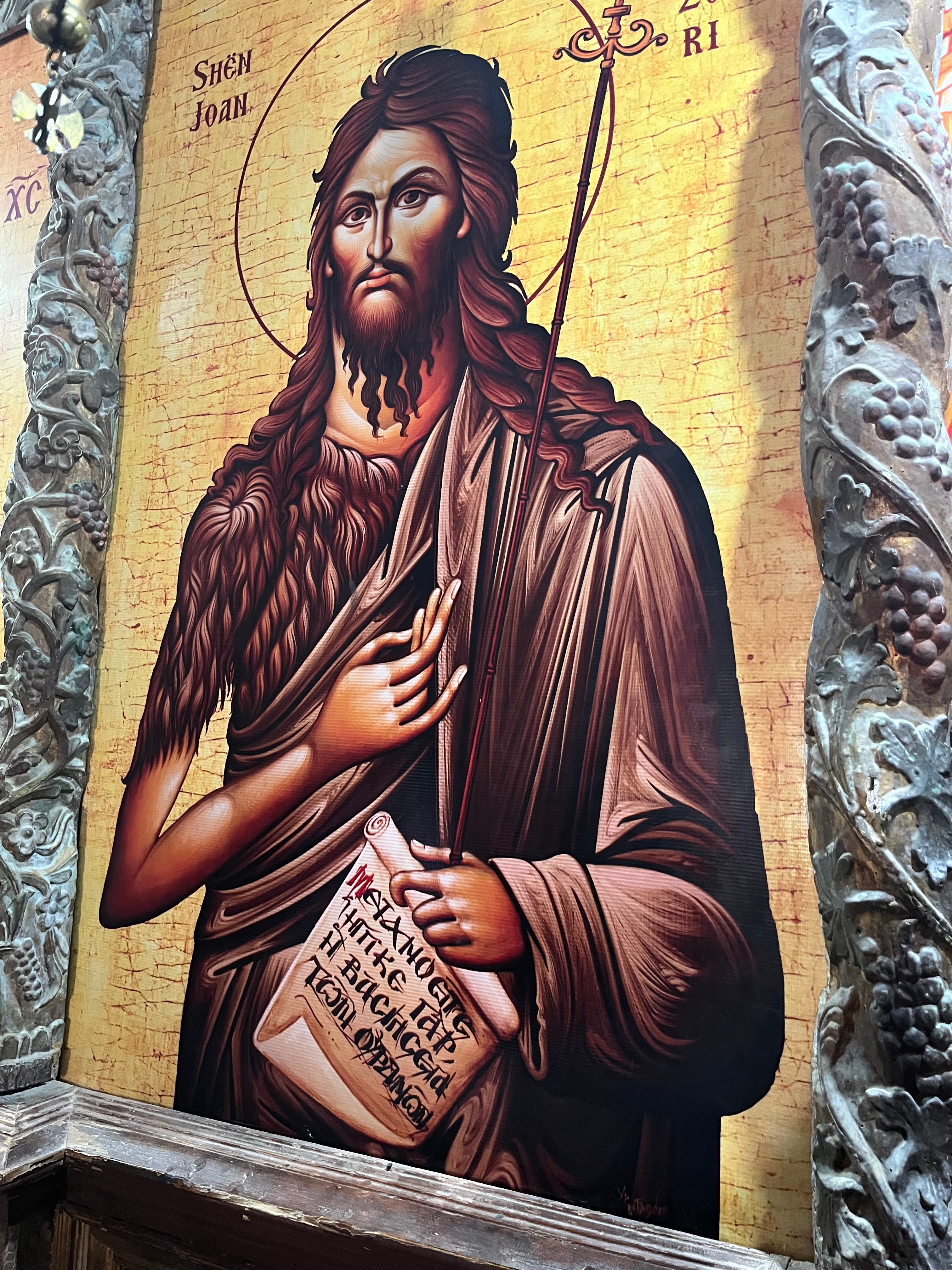
The chapel is a Byzantine sugar-rush: circular-tiled mosaic floor, silk carpets, carved altar and a top line-up of icons: Madonna and Child looking a bit airbrushed, my mate St Mark looking cool, white-bearded and scholarly and a properly rock ‘n’ roll John the Baptist (lapsed comedian Russell Brand has so been checking out his Johns).
The museum has a small but stimulating collection, covering the Greek and Roman eras. From the fourth century BCE, Apollonia was a prosperous and significant city for both civilisations. That the collection is not larger and more stimulating says something about more recent Albanian history.
Apollonia, which used to be on the sea, declined when the waterways silted up. That preserved the ruins until the site was comprehensively mapped and excavated by a French archeologist in the 1920s. The museum was set up in 1958. One of Hoxha’s bulldozers destroyed some of the precious remains and in the chaos following the fall of communism, the looters got to work. The treasures that didn’t end up on the black market were moved to Tirana for safekeeping.
Today, and this is very much a sign of modern Albania, the site is as well-kept and as well-run as any in Greece and Italy, without the overbearing commerciality you often find in those places. Pompeii and Delphi it’s not, but if you love sauntering among the birdsong, oaks and pines next to an intact amphitheatre and standing Doric column, Appolonia is a first class place to visit.
On the way back, we stopped at another St Mary’s, a 13th century island monastery sitting lonely and tranquil across a wooden bridge near the wooded village of Zvërnec. Less lonely and tranquil were our taxi drivers, who coordinated their activities in great whoops, hollers and horns.
International men of mystery
We began our tour a few days earlier in the northern city of Shkodër.
Albania has variously been compared to the Maldives and the Riviera, but here, in the shadow of the Albanian Pennines (actually, Alps), it was more like Albania’s version of Manchester: wet, cold and architecturally not very distinguished.
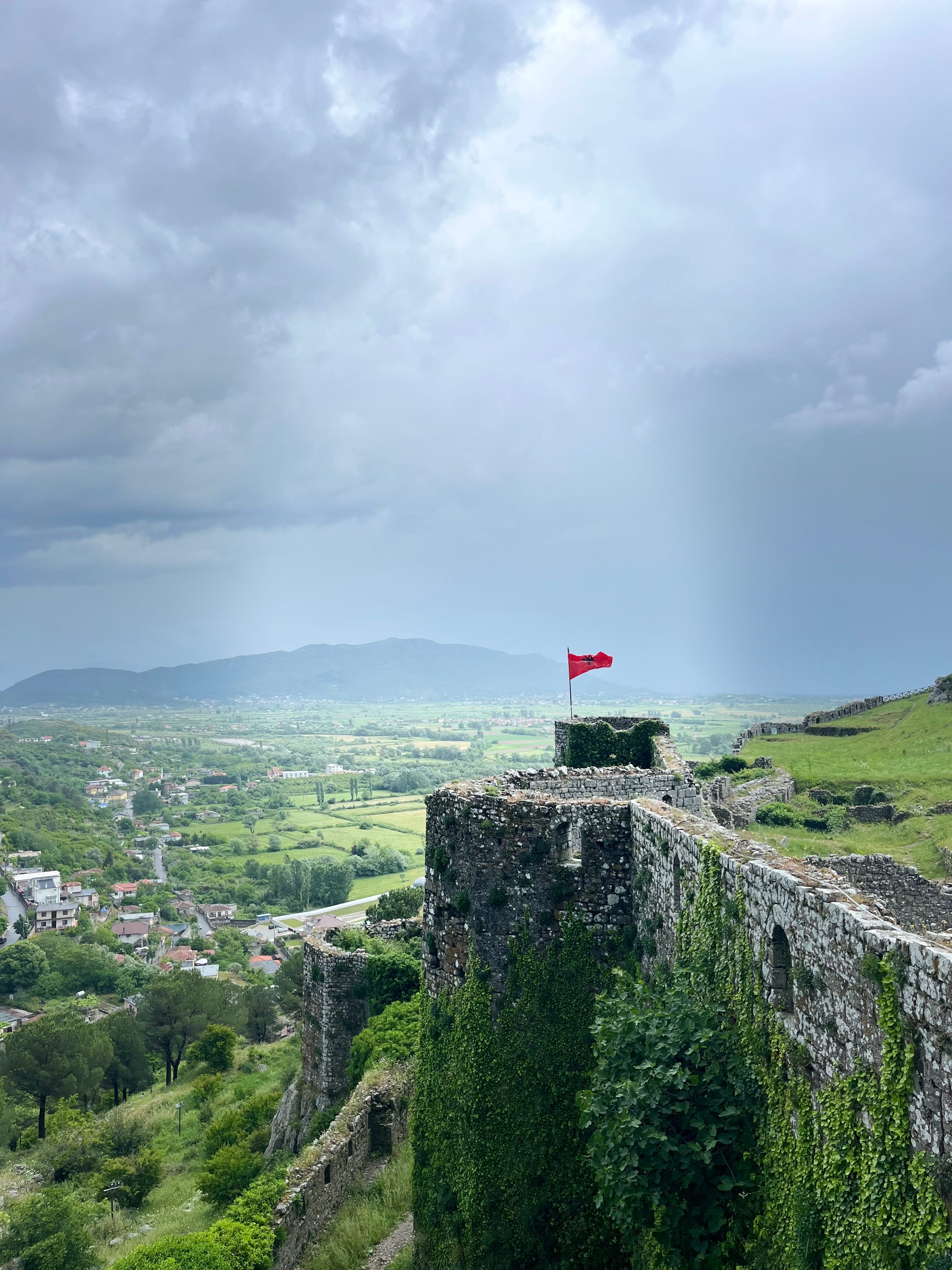
They called off our football match because of the rain, something that rarely happens in Manchester. Needing somewhere to get properly drenched, we went up to the exposed remains of Shkodër’s redoubtable castle on a hillside above the Drin and Buna rivers, and looked out on the valleys where Greeks, Romans, Albanians and Ottomans have vyed for this strategic land.
It’s also a place where ancient myths and archetypes waft in from the Ionian and Adriatic seas. In order to stop the castle falling down, Rozafa, the wife of the youngest of three princes, agreed to be buried alive in the walls. The castle and, indeed, our hotel, were named after her.
I left one name off that list of occupying peoples – the Illyrians, who dominated the Balkan peninsula from the 9th century BCE until their King, Gentius, was defeated by the Romans near the site of the castle in 168 BCE.
The Illyrians, like, say, the Phoenicians and Nabateans are one of those frustrating civilisations who were everywhere in classical and late antiquity, left a very clear mark on their land and in the annals of their invaders, but didn’t bother to write down much themselves.
That meant subsequent writers could make up a load of stuff about them and their land without fear of being challenged. This brings me to an excellent posh pub-quiz question: which ancient kingdom links the plays of William Shakespeare and Jean Paul-Sartre?
You probably got it.
Shakespeare set Twelfth Night in Illyria. He’s really doing a Jacobean Love Island for the oversexed, gender-fluid party people of the new King James court at the end of a Christmas period of partying and pairing off. Illyria must have sounded kind of classical, kind of sexy and to quote Byron, a future poet who had much ado with Albania, What men call gallantry, and gods adultery/Is much more common where the climate’s sultry.
If Twelfth Night is all sun, sea and cross-garters. Sartre is all overcoats, Gitanes and existentialist angst. The French philosopher had a very different agenda when he set Les Main Sales (1948) in Illyria. It deals with Communism, Fascism, political assasination and erectile dysfunction. Illyria becomes an all-purpose tortured Iron Curtain state.
As it turned out, Illyria/Albania would evolve into an Iron Curtain state unlike any other, ever.
Albania: on a lonely planet
I’d seen Albania before, but only from 30,000 feet as various holiday planes I was on approached the coast of Greece. I am almost certainly retrofitting what I saw in the knowledge of what I now know about the country between the 1970s and 1990s – but it looked barren and silent as a different planet.
What was happening? Hoxha had successively broken with Russia, China and his nominally socialist Yugoslavian neighbours. He had nothing to do with the West, of course, and, given that Albania played little or no part in the Cold War games, the West could safely ignore Albania.
Hoxha’s regime (1944-85) is routinely compared to North Korea today. But even Kim Jong-un has the odd visitor when we wants to buy armaments or export cannon fodder. Hoxha had nothing to do with the outside world. A better comparison is Japan during the Sakoku period.
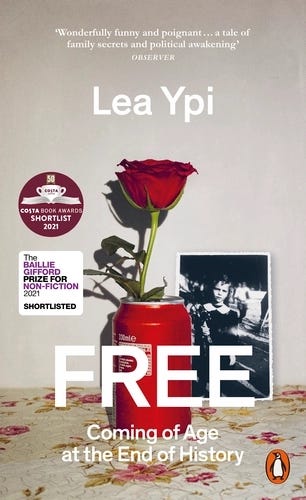
What was it like growing up under Uncle Enver? Thanks to my occcasional strike partner4 Pete West, I picked up Lea Ypi’s memoir Free. It’s a wryly written and cleverly constructed book. The first half is about the pre-teen Ypi and her trust in and adoration for Albania’s leader. She is dimly aware that something isn’t quite right in her family – something about their, and her ‘biography’. There are stories about relatives going to university and having an unhappy time there.
Hoxha dies, the mad freedoms of the 1990s arrive, Albanians depart en masse and Lea learns the truth – her family were rich landowners before the revolution and dissidents, real and suspected – since. ‘University’ was code for the secret service torture cells.
Free is subtitled Coming of Age at the End of History. Dictatorship must infantilise if it is to survive. Children and young adults, as Mao knew when he formed the Red Guards and the ayatollahs when they co-opted students in 1979, are the perfect subjects: trusting, zealous, living in a cartoon world where shades of moral complexity do not exist.
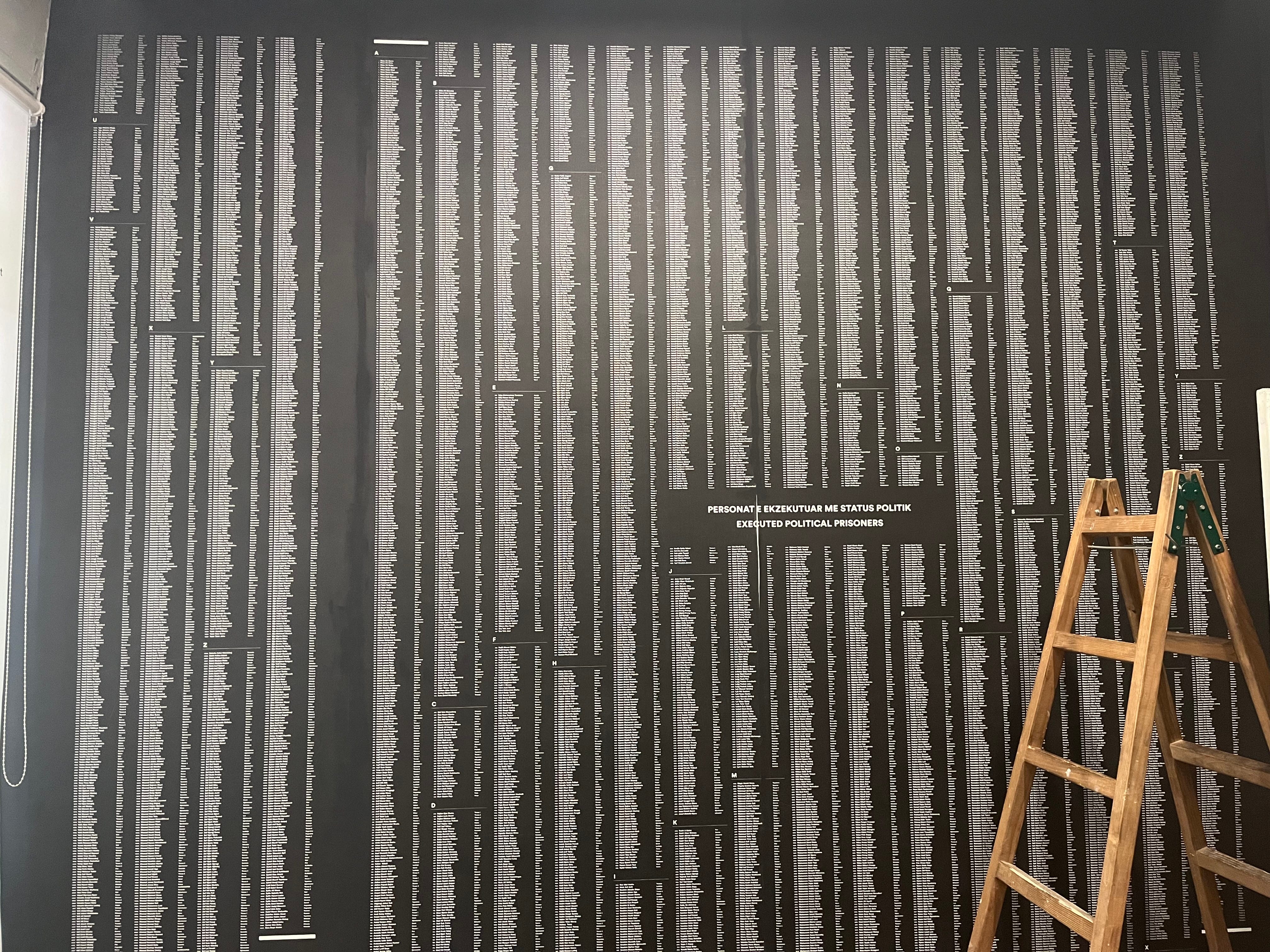
To see the other side of Hoxha’s fairy story, go to the House of Leaves in central Tirana. This converted middle class mansion is a testament to the victims of Hoxha’s repression. I’ve been to a few of these Communist-era museums and this is a tough watch. The depictions of torture and the haunted faces of the prisoners at the show trials are hard enough. But most eloquent is the simple black and white list of executed political prisoners. The smaller the type, the worse the atrocity, the greater the narcissism of the leader responsible.
A pyramid without a pharaoh
More on the present and future of Albania in the next blog. But let’s not leave Albania in the House of Leaves’ gloomy cells.
A short walk from there is the Pyramid of Tirana.
It is popularly thought to have been constructed as a mausoleum for Enver Hoxha. It’s certainly the kind of structure that’d be on most 20th century dictator’s wishlists, along with the nuclear bomb shelter (we visited Hoxha’s in the northern suburbs), the thousands of police informers and the May Day military parade. But there is no entombed Marxist pharaoh here: it was built by Hoxha’s family and opened in 1988 as a museum celebrating his many achievements.
Albania belatedly joined the collapse-of-communism party in the early 1990s; and no-one was in much of a mood for celebrating Hoxha’s many achievements.
When Shelly wrote the go-to sonnet about hubris and posterity, his Ozymandias, having invited us to ‘Look on my works, ye Mighty, and despair!’, ends up with nothing but the legs and head of a fallen sculpture. The modern version is to have the monumental tribute to your life turned into a conference centre and a ‘a youth-oriented information technology centre’.
Lots of Albanians are all for demolishing it. I’m glad they didn’t. I guess the family thought it’d be a powerful reminder of Hoxha’s omnipotence in the heart of Tirana. Instead, it looks like one of the 1970s shopping centres or halls of residence that proliferated in Britain and, doubtless, elsewhere during the 70s and 80s.
Maybe it could also be redesignated as a memorial to the financial collapse of 1996-7 that led to perhaps two-thirds of Albanians losing their savings and sparked mass violence? It was, after all, one great pyramid scheme.
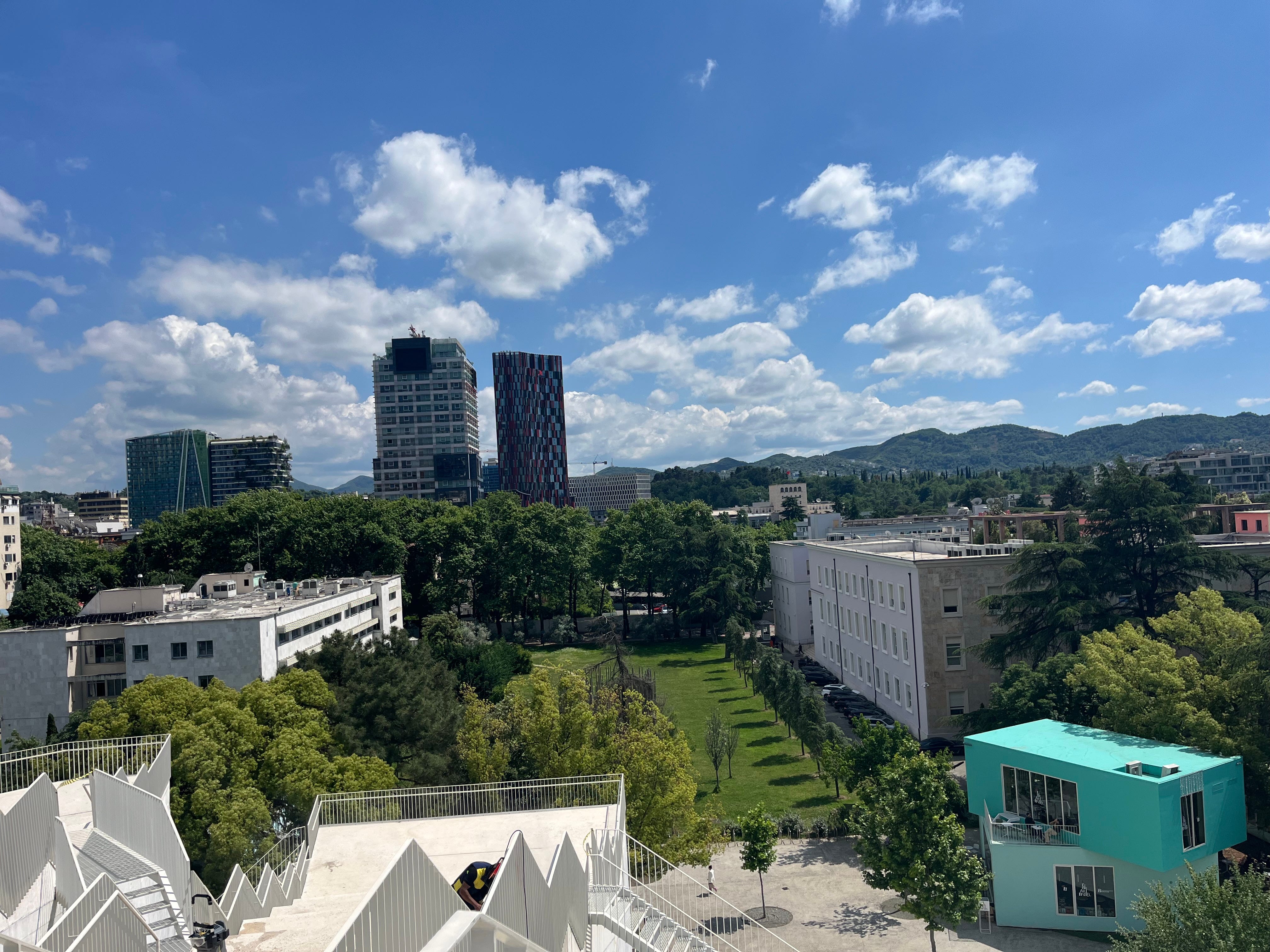
Anyway, history, history. Today, from the summit, you look down not on the grim and troubled Tirana of legend, but a clean, green, open, quiet city. I didn’t expect to be reminded of New World cities like Brisbane and Auckland, but I was.
Let’s end with the deadening effect of too much travel
We people who travel a lot, we all do it, don’t we? Oh, that lake reminds me a bit of Tasmania – or is it Austria? That dance – I saw a very similar thing in Jeddah last year. I didn’t expect to be reminded of New World cities like Brisbane and Auckland, but I was.
In Lea Ypi’s Free, Albania has opened up and the technocrats from the World Bank have moved in. The Somewheres, the people who have not been allowed to travel at all are suddenly exposed to the Anywheres, individuals who have done nothing but travel.
One is a very worldly and cosmopolitan Dutchman called Vincent. Whatever strange and hyper-local Albanian phenomenon he encounters, he responds with a phrase like ‘We had the same when we used to stay in…’
‘Replicability was his secret weapon,’ writes Ypi:
It didn’t offend us to learn that we weren’t teaching Vincent anything new, but there was something troubling about the discovery that what we though was uniquely ours wasn’t so distinctive after all; that everything we had assumed stood out was part of a familiar pattern for those who knew the ways of the world. The dishes we shared with other cuisines, the rhythms of traditional songs and dances, the sounds of the language, all seemed to belong not just to us but to others too; it was our fault for not knowing this.
Or, expressed in t-shirt slogan terms: Let’s keep the world weird.
ps More on the Racing Club’s adventures here (paid subscribers only – what do you mean you’re not? There can’t be an easier or more pleasant way to part with the price of an average pub dinner).
Or ’spluttered along a meandering path’
Milling around indecisively, aka The Blackheath Shuffle, is a club trademark, rather like Barcelona’s tiki-taka or Borussia Dortmund’s Gegenpressing
This we failed to do when we toured Hoxha’s nuclear bunker outside Tirana. When we told the ‘guide’ (a random bloke hanging around the ticket office) that he had to do the whole thing in 45 minutes rather than the minimum four hours he had in mind, he spent the whole time in a strop, denied, as he was, the proper space to vent various theories about Cold War politics and tell the usual pathetic tour-guide jokes
A phrase which may confuse non-footballers